In today’s competitive marketplace, cultivating lasting customer relationships is paramount. Loyalty programs, strategically designed and implemented, offer a powerful mechanism for boosting customer retention and fostering brand advocacy. This exploration delves into the multifaceted aspects of creating and managing effective loyalty programs, examining various structures, reward systems, and crucial metrics for success.
We will navigate the intricacies of designing programs that resonate with specific target audiences, highlighting the importance of seamless integration with customer service initiatives. Case studies of successful loyalty programs across diverse industries will provide practical insights and illuminate best practices. Furthermore, we will examine emerging trends and the transformative role of technology in shaping the future of customer loyalty.
Incentivizing Customer Loyalty
A successful loyalty program hinges on offering compelling rewards that incentivize repeat business and foster a strong customer-brand relationship. By strategically designing a system that provides increasing benefits with higher engagement, businesses can cultivate a loyal customer base that actively contributes to their growth. This involves understanding customer preferences and offering a diverse range of rewards tailored to those preferences.Reward programs should go beyond simple discounts; they should create a sense of community and appreciation.
A well-structured program offers multiple avenues for customers to earn and redeem rewards, increasing their engagement and perceived value.
Types of Rewards Offered in Loyalty Programs
Offering a variety of rewards caters to diverse customer preferences, ensuring broader appeal and participation. A balanced approach encompassing monetary and non-monetary incentives enhances the overall program’s effectiveness.
- Points-based systems: Customers earn points for purchases, which can be redeemed for discounts, free products, or other rewards. For example, a coffee shop might award 1 point per dollar spent, with 100 points equating to a free drink.
- Tiered discounts: Higher spending levels unlock progressively larger discounts on future purchases. A clothing retailer might offer 10% off for bronze members, 15% for silver, and 20% for gold.
- Exclusive access: Loyalty program members gain access to special events, early sales, or limited-edition products unavailable to the general public. Imagine a concert venue offering early ticket access and exclusive meet-and-greets to its VIP members.
- Free products or services: Offering free items or services after reaching certain milestones encourages repeat business. A gym might offer a free month of membership after 12 months of continuous attendance.
- Cashback rewards: Customers receive a percentage of their spending back as cash, often credited to their account or a linked payment method. This is a direct and appealing incentive, similar to a store credit reward.
Designing a Tiered Reward System
Tiered systems create a sense of progression and achievement, motivating customers to increase their engagement. Each tier offers increasingly valuable benefits, rewarding higher levels of loyalty.
- Bronze Tier (Entry Level): Basic rewards like small discounts (5-10%), early access to sales, and birthday rewards.
- Silver Tier (Mid-Level): Increased discounts (15-20%), free shipping, exclusive access to online content or events, and potentially a dedicated customer service line.
- Gold Tier (High-Level): Significant discounts (25%+), exclusive events, personalized gifts, priority customer service, and potentially partner discounts.
Non-Monetary Rewards Enhancing Customer Experience
Non-monetary rewards often carry a higher perceived value, strengthening the customer-brand connection and fostering a sense of belonging.
- Personalized communications: Tailored emails, birthday messages, or special offers based on past purchases show customers that the brand values their individual preferences.
- Exclusive content: Access to behind-the-scenes content, interviews, or webinars can build brand affinity and foster a sense of community.
- Early access to new products or features: Allowing loyal customers to try new offerings before the general public creates a sense of exclusivity and appreciation.
- Personalized recommendations: Suggesting products or services based on past purchases enhances the shopping experience and demonstrates a genuine understanding of customer needs.
- Opportunities for feedback and engagement: Inviting customers to participate in surveys, focus groups, or beta testing programs shows that their opinions are valued.
Measuring Loyalty Program Effectiveness
Understanding the effectiveness of a loyalty program is crucial for maximizing its return on investment and ensuring its continued contribution to customer retention. Effective measurement involves tracking key metrics, analyzing customer behavior, and calculating the program’s financial impact. This allows businesses to identify what’s working, what’s not, and to make data-driven adjustments to optimize the program’s performance.Key Metrics for Loyalty Program Success and Customer Retention RatesSeveral key metrics provide valuable insights into a loyalty program’s performance and its impact on customer retention.
These metrics offer a comprehensive view of the program’s effectiveness, allowing for targeted improvements.
Customer Retention Rate
Customer retention rate is a fundamental metric, measuring the percentage of customers retained over a specific period. A higher retention rate indicates a successful program. It’s calculated by subtracting the number of customers lost from the number of customers at the beginning of the period, dividing the result by the initial number of customers, and multiplying by 100.
For example, if a company started with 1000 customers and lost 100 over a year, the retention rate would be (1000 – 100)/1000100 = 90%. This signifies that 90% of customers remained loyal. Analyzing trends in this metric over time reveals the program’s long-term impact.
Member Acquisition Cost
This metric calculates the cost of acquiring a new loyalty program member. It’s determined by dividing the total cost of the loyalty program’s marketing and operational expenses by the number of new members acquired. For instance, if a company spent $10,000 on loyalty program marketing and acquired 500 new members, the member acquisition cost would be $20 per member.
Tracking this metric helps optimize acquisition strategies and ensure cost-effectiveness.
Average Customer Lifetime Value (CLTV)
CLTV represents the total revenue a business expects to generate from a single customer throughout their relationship. A higher CLTV indicates that the loyalty program is effectively increasing customer engagement and spending. There are various methods for calculating CLTV, but a common approach involves estimating the average purchase value, purchase frequency, and customer lifespan. A higher CLTV signifies a successful program’s ability to foster long-term customer relationships.
For example, a coffee shop might estimate the average purchase value at $5, purchase frequency at twice a week, and customer lifespan at 2 years. This translates to a CLTV of approximately $1040.
Redemption Rate
The redemption rate measures the percentage of loyalty points or rewards redeemed by members. A low redemption rate suggests potential issues with the reward structure or program accessibility. A high rate shows that members find the rewards appealing and accessible. For example, if 500 out of 1000 members redeem their points, the redemption rate is 50%. Analyzing this metric helps optimize the rewards offered.
Analyzing Customer Behavior Data
Analyzing customer behavior data provides valuable insights for improving the loyalty program. This involves examining various data points to identify trends and areas needing attention.
Customer Segmentation and Behavior Analysis
By segmenting customers based on demographics, purchase history, and engagement levels, businesses can tailor rewards and communications to specific groups. Analyzing purchase patterns, reward preferences, and channel usage reveals valuable insights into customer behavior and preferences. This allows for the personalization of rewards and communication strategies. For instance, a retailer might segment customers into high-value, medium-value, and low-value buyers, offering customized rewards and promotions to each group.
Return on Investment (ROI) Calculation
Calculating the ROI of a loyalty program helps demonstrate its financial impact. This is achieved by comparing the program’s costs against the revenue generated or cost savings achieved.
ROI Calculation Method
A simple ROI calculation for a loyalty program involves subtracting the total cost of the program from the incremental revenue generated, dividing the result by the total cost, and multiplying by 100. For example, if a loyalty program cost $50,000 and generated an additional $100,000 in revenue, the ROI would be (($100,000 – $50,000) / $50,000)100 = 100%. This indicates that the program generated a 100% return on investment.
This calculation should also consider cost savings from reduced customer acquisition costs or improved customer retention.
Integrating Loyalty Programs with Customer Service
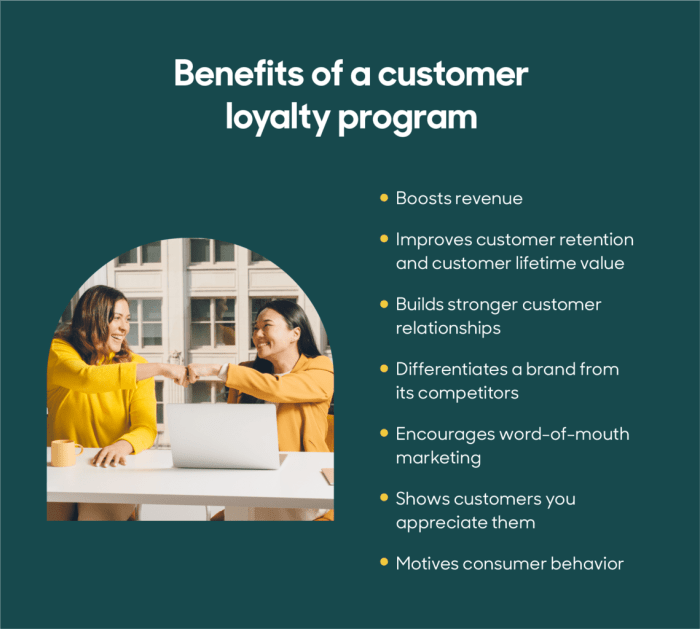
A successful loyalty program isn’t just about rewarding customers; it’s about fostering a strong, positive relationship built on consistent, high-quality interactions. Seamless integration between your loyalty program and customer service is crucial for maximizing its effectiveness and ensuring customer satisfaction. When these two vital aspects of your business work in harmony, you cultivate loyalty that translates into repeat business and positive word-of-mouth referrals.Positive customer service experiences significantly amplify the perceived value of a loyalty program.
A customer who receives prompt, helpful, and friendly service is more likely to appreciate and actively engage with the rewards offered. Conversely, negative service experiences can quickly diminish the appeal of even the most generous loyalty program, leading to customer churn. Therefore, training and aligning your customer service team with the goals and mechanics of your loyalty program is a critical investment.
Customer Service Training Modules for Loyalty Program Inquiries
Effective handling of loyalty program inquiries requires specialized training for your customer service representatives. The following modules provide a structured approach to equip your team with the knowledge and skills necessary to deliver exceptional service in this context.
- Module 1: Understanding the Loyalty Program Mechanics. This module provides a comprehensive overview of the loyalty program’s rules, benefits, point accrual systems, redemption processes, and any specific promotional offers. Representatives will learn to navigate the program’s structure and answer common questions with accuracy and confidence. This will involve practical exercises using real-life scenarios and simulated customer interactions.
- Module 2: Handling Common Inquiries and Complaints. This module focuses on addressing frequently asked questions (FAQs) regarding points balance, reward redemption, program eligibility, and technical issues. It will also equip representatives with effective strategies for handling customer complaints and resolving issues related to the loyalty program, such as discrepancies in points or difficulties with redemption. Role-playing scenarios will be used to practice conflict resolution and de-escalation techniques.
- Module 3: Utilizing Loyalty Program CRM Systems. This module trains representatives on the effective use of the Customer Relationship Management (CRM) system integrated with the loyalty program. It covers accessing customer profiles, viewing transaction history, managing points balances, and resolving issues efficiently within the system. Hands-on training will ensure proficiency in using the system’s functionalities.
- Module 4: Proactive Loyalty Program Promotion. This module focuses on educating representatives on how to proactively promote the loyalty program during customer interactions. It will cover techniques for effectively communicating the program’s benefits and encouraging customer participation. This includes scripting effective dialogue to introduce the program and highlight its advantages for customers.
Future Trends in Loyalty Programs
Loyalty programs are evolving rapidly, driven by advancements in technology and a deeper understanding of customer behavior. The future of loyalty hinges on personalization, seamless integration across channels, and the strategic use of data to create truly valuable and engaging experiences for customers. This shift necessitates a move beyond simple points-based systems towards more holistic, relationship-focused approaches.The role of personalization and data analytics is becoming increasingly crucial in enhancing loyalty programs.
By leveraging customer data, businesses can tailor rewards, offers, and communications to individual preferences, creating a more relevant and engaging experience. This targeted approach fosters stronger customer relationships and drives higher engagement and retention rates. Effective data analysis helps identify customer segments, predict behavior, and optimize program design for maximum impact.
Personalization and Data Analytics in Loyalty Program Enhancement
Effective personalization requires a robust data infrastructure capable of collecting, analyzing, and interpreting vast amounts of customer information. This data, encompassing purchase history, browsing behavior, demographics, and even social media activity, is used to create detailed customer profiles. These profiles inform targeted marketing campaigns, personalized recommendations, and customized reward structures. For example, a coffee shop might offer a free pastry to a customer who frequently buys lattes, while offering a discount on whole bean coffee to a customer who consistently purchases large quantities.
This level of personalization goes beyond simple segmentation and moves towards individual-level tailoring, creating a unique and valued experience for each customer. Furthermore, predictive analytics can anticipate customer needs and proactively offer relevant rewards or promotions, further strengthening the customer-brand relationship.
Innovative Loyalty Program Features Leveraging New Technologies
Several innovative features are transforming loyalty programs, leveraging the power of mobile apps and AI. Mobile apps offer a convenient platform for managing loyalty points, accessing exclusive offers, and engaging with the brand. AI-powered chatbots can provide instant customer support, answer queries about points balances, and even personalize recommendations based on individual preferences. For example, a retailer might use an AI-powered chatbot to assist customers with returns or exchanges, providing a seamless and efficient experience that enhances loyalty.
Another example could be a travel company utilizing AI to curate personalized travel itineraries based on a customer’s loyalty tier and past travel history, enhancing their overall experience and increasing their propensity to book future trips through the same company. Gamification features within mobile apps, such as progress bars, badges, and leaderboards, can further increase engagement and encourage repeat purchases.
Visualizing Loyalty Program Data
Understanding the effectiveness of a loyalty program requires more than just looking at raw numbers; it demands a clear visual representation of the data to reveal trends and insights. Visualizations help stakeholders quickly grasp the program’s impact on key metrics like customer retention and engagement. By effectively presenting this data, businesses can make data-driven decisions to optimize their loyalty programs and improve overall customer relationships.Effective visualization is crucial for understanding the complex relationship between loyalty program participation and key business outcomes.
Well-designed charts and graphs can clearly illustrate patterns, allowing for better strategic planning and resource allocation. This section explores two key visualizations: the relationship between loyalty program participation and customer retention, and the distribution of customer engagement levels within the program.
Loyalty Program Participation and Customer Retention
A scatter plot effectively illustrates the relationship between loyalty program participation (measured, for example, by points earned or transactions made) and customer retention (measured by the length of time a customer remains active). Each point on the graph represents a single customer, with the x-axis showing their loyalty program activity and the y-axis showing their retention period. A positive correlation would show that higher loyalty program participation is associated with longer customer retention.
For example, a strong positive correlation might be visually represented by a cluster of points trending upwards from the bottom left to the top right of the graph. Conversely, a weak correlation or even a negative correlation would indicate that the loyalty program is not effectively driving retention. Further analysis could then explore reasons for this, such as insufficient rewards or lack of engagement with the program’s features.
The visualization could also incorporate color-coding to segment customers based on demographics or purchase history, providing a richer understanding of the relationship.
Distribution of Customer Engagement Levels
A histogram provides a clear picture of the distribution of customer engagement levels within a loyalty program. The x-axis would represent different levels of engagement (e.g., low, medium, high), categorized by metrics such as frequency of purchases, points earned, or interactions with the program’s app or website. The y-axis would represent the number of customers falling into each engagement level.
A normal distribution, with a majority of customers clustered around the medium engagement level, would suggest a healthy program. A skewed distribution, with a large proportion of customers at the low engagement level, might indicate a need for improvements in program design or communication. For instance, a significant portion of customers in the low engagement bracket might signal a need for more attractive incentives or more personalized communications.
The histogram can be further enhanced by adding color-coding or annotations to highlight specific customer segments or trends.
Ultimately, successful customer retention hinges on a holistic approach that prioritizes exceptional customer service and strategically designed loyalty programs. By understanding the core components of a robust loyalty program, leveraging data-driven insights, and consistently adapting to evolving customer expectations, businesses can cultivate enduring customer relationships, driving sustained growth and profitability. The journey to building a thriving loyalty program is an ongoing process of refinement and innovation, demanding continuous monitoring and adaptation to achieve optimal results.
FAQ Corner
What is the ideal frequency for rewarding loyal customers?
The optimal frequency depends on your program’s structure and customer engagement. Consistency is key, but avoid overwhelming customers with too many rewards. A balance between regular rewards and occasional special offers often works best.
How can I measure the ROI of my loyalty program?
Track key metrics like customer retention rate, average purchase value, and customer lifetime value. Compare these metrics before and after program implementation. Also, consider the program’s costs (rewards, administration) to calculate the net return.
How do I handle customer complaints related to the loyalty program?
Establish a clear process for addressing complaints promptly and empathetically. Offer immediate solutions whenever possible, and ensure that customers feel heard and valued. Use feedback to improve the program’s design and functionality.
What technologies can enhance my loyalty program?
Consider integrating CRM software for personalized communication, mobile apps for easy access to rewards, and data analytics tools for performance tracking and optimization. AI-powered personalization features can further enhance the customer experience.


