
Cultivating lasting customer relationships is paramount for business success. This exploration delves into the multifaceted strategies employed to retain customers, examining key elements from understanding customer needs to leveraging technology for personalized interactions. We’ll navigate the intricacies of building strong relationships, enhancing customer service, and measuring the effectiveness of retention efforts, all while showcasing real-world examples of companies that have mastered the art of customer retention.
From defining customer retention and its core metrics to implementing loyalty programs and utilizing data analytics, we’ll provide a comprehensive overview of the strategies that drive customer loyalty and minimize churn. The journey will include practical advice, actionable steps, and insightful case studies, equipping you with the knowledge and tools necessary to improve your own customer retention rates.
Defining Customer Retention
Customer retention is a cornerstone of sustainable business success. It’s significantly more cost-effective to retain existing customers than to acquire new ones, leading to increased profitability and long-term growth. Understanding and implementing effective retention strategies is crucial for any business aiming for lasting prosperity.Customer retention refers to the strategies and practices a business employs to keep its existing customers engaged and loyal over time.
It’s about building lasting relationships that encourage repeat purchases and positive word-of-mouth referrals. Key metrics used to measure customer retention include customer churn rate (the percentage of customers lost over a specific period), customer lifetime value (CLTV, the total revenue a customer is expected to generate throughout their relationship with the business), and retention rate (the percentage of customers retained over a specific period).
Analyzing these metrics provides valuable insights into the effectiveness of retention strategies and areas for improvement.
Customer Retention Rate Examples
High customer retention is often associated with businesses that prioritize customer experience and build strong relationships. For example, companies like Apple consistently demonstrate high retention rates due to their loyal customer base attracted by a combination of high-quality products, excellent customer service, and a strong brand image. This fosters customer loyalty, resulting in repeat purchases and positive word-of-mouth marketing.
Conversely, businesses with low retention rates often struggle with issues such as poor customer service, subpar product quality, or a lack of engagement with their customer base. A hypothetical example would be a small, local restaurant that receives numerous negative online reviews due to inconsistent food quality and slow service. This can lead to high customer churn and ultimately, business failure.
The contrast highlights the significant impact of customer retention on a business’s long-term viability.
Understanding Customer Needs and Expectations
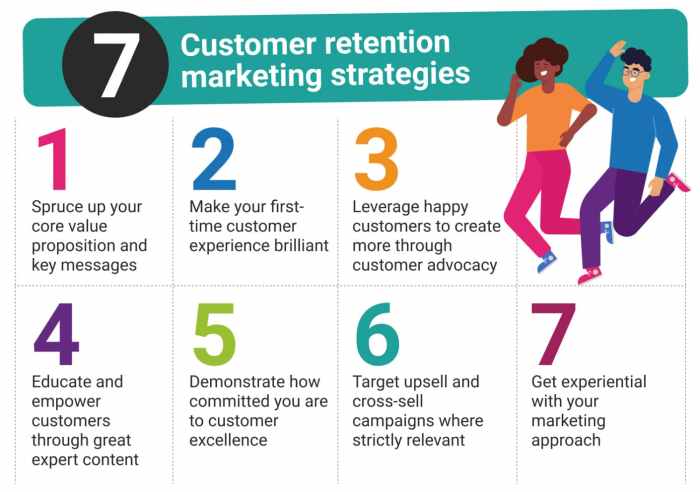
Effective customer retention hinges on a deep understanding of what your customers truly value. Ignoring their needs and expectations is a surefire path to losing them to competitors. This section will explore key factors influencing customer satisfaction and loyalty, discuss effective segmentation strategies, and detail how to implement a robust feedback mechanism.Understanding your customer base goes beyond simply knowing their demographics.
It requires actively listening to their needs and anticipating their expectations. This involves a multi-faceted approach that incorporates various data sources and analysis techniques to build a comprehensive picture of your customer’s journey.
Key Factors Influencing Customer Satisfaction and Loyalty
Customer satisfaction and loyalty are driven by a complex interplay of factors. Addressing these factors directly is crucial for effective retention strategies. These factors often fall under the umbrellas of product quality, customer service, and overall brand experience. High-quality products or services that meet or exceed expectations form the foundation. However, exceptional customer service and a positive brand experience are equally important in building lasting relationships.
Customer Segmentation Strategies for Targeted Retention Efforts
Effective customer retention isn’t a one-size-fits-all approach. Dividing your customer base into distinct segments based on shared characteristics allows for targeted strategies that resonate more effectively. This segmentation can be based on various factors, such as demographics (age, location, income), purchasing behavior (frequency, value, product preference), and engagement levels (website activity, social media interactions).For example, a company might segment its customers into “high-value,” “mid-value,” and “low-value” segments based on their lifetime value (LTV).
High-value customers might receive personalized offers and exclusive benefits, while mid-value customers might receive targeted promotions. Low-value customers might receive more generic marketing messages or be offered incentives to increase their engagement. Another approach might segment by product usage; for example, a software company might segment users based on feature usage to tailor onboarding and support.
Designing a Customer Feedback Mechanism
Gathering customer feedback is essential for continuous improvement and better retention. Implementing a robust feedback mechanism allows you to proactively address concerns, identify areas for improvement, and enhance customer experience. This can include various methods such as surveys (online, email, in-app), feedback forms on websites, social media monitoring, customer support interactions, and focus groups.A well-designed survey should be concise, focused on specific aspects of the customer journey, and easy to complete.
For instance, a post-purchase survey could focus on aspects such as product satisfaction, delivery experience, and customer service interaction. Analyzing feedback from multiple sources provides a more holistic view of customer sentiment and allows for data-driven decision-making to improve retention efforts.
Enhancing Customer Service and Support
Exceptional customer service is the cornerstone of any successful customer retention strategy. Proactive and responsive support builds trust, fosters loyalty, and ultimately translates into repeat business and positive word-of-mouth referrals. By consistently exceeding customer expectations, businesses cultivate a strong customer base that actively champions their brand.Proactive Customer Service in Retention StrategiesProactive customer service goes beyond simply reacting to customer issues; it anticipates needs and addresses potential problems before they arise.
This approach demonstrates a genuine commitment to customer satisfaction and strengthens the customer-business relationship. For example, sending personalized emails based on past purchases or offering helpful tips and resources related to a product can show customers that you value their business and are invested in their success with your offerings. This proactive approach builds trust and loyalty far more effectively than a purely reactive approach.
Best Practices for Handling Customer Complaints and Resolving Issues Efficiently
Effective complaint handling is crucial for retaining customers. A well-managed complaint process can transform a negative experience into an opportunity to strengthen the customer relationship. Ignoring or mishandling complaints, however, can quickly lead to customer churn.
- Acknowledge the complaint promptly and empathetically. Let the customer know you understand their frustration and are committed to finding a solution.
- Actively listen to the customer and avoid interrupting. Understanding their perspective is key to finding a resolution.
- Take ownership of the problem, even if it’s not directly your fault. Avoid placing blame.
- Offer a sincere apology for the inconvenience caused.
- Work collaboratively with the customer to find a mutually agreeable solution. Be flexible and willing to compromise.
- Follow up with the customer to ensure they are satisfied with the resolution.
- Document all interactions with the customer, including the complaint, the solution, and the follow-up.
Utilizing Various Communication Channels for Exceptional Customer Support
Choosing the right communication channel is vital for providing efficient and effective customer support. Each channel has its strengths and weaknesses, and the best approach often involves a multi-channel strategy.
| Channel | Pros | Cons |
|---|---|---|
| Asynchronous communication allows for detailed responses and record-keeping; convenient for the customer; allows time for considered responses. | Can be slow; requires customers to be comfortable with written communication; can lead to misunderstandings due to lack of immediate feedback. | |
| Phone | Allows for immediate interaction and clarification; facilitates a more personal connection; suitable for complex issues requiring immediate attention. | Can be time-consuming; requires immediate availability of staff; difficult to track and document interactions effectively; can be less convenient for customers. |
| Chat | Offers real-time support; convenient for customers; allows for quick resolution of simple issues; easily integrates with websites. | Limited capacity for complex issues; requires trained personnel; can be impersonal; can be affected by technical glitches. |
Leveraging Technology for Customer Retention
In today’s digital landscape, technology plays a pivotal role in fostering customer loyalty and driving retention. By strategically integrating data analytics, marketing automation, and social media engagement, businesses can cultivate stronger relationships with their customers, ultimately boosting profitability and long-term success. Effective utilization of these technologies allows for a more personalized, proactive, and efficient approach to customer interaction.Data analytics provides invaluable insights into customer behavior, enabling businesses to proactively address potential churn.
By analyzing various data points, companies can identify at-risk customers and implement targeted strategies to retain them. This proactive approach is significantly more cost-effective than reactively addressing customer attrition.
Identifying At-Risk Customers Through Data Analytics
Data analytics offers a powerful means to identify customers likely to churn. By analyzing historical data such as purchase frequency, average order value, website engagement, customer service interactions, and social media activity, businesses can create predictive models. These models identify patterns and indicators associated with customer churn. For example, a significant drop in purchase frequency coupled with negative feedback on social media might flag a customer as high-risk.
Companies can then proactively reach out to these customers with personalized offers or improved support to mitigate the risk of churn. This approach allows for targeted interventions, maximizing the impact of retention efforts and optimizing resource allocation.
Personalizing Customer Interactions with Marketing Automation Tools
Marketing automation tools empower businesses to personalize customer interactions at scale. These tools allow for automated email campaigns, personalized website content, and targeted advertising based on customer segmentation and behavior. For instance, a clothing retailer could use automation to send personalized email recommendations based on past purchases and browsing history. Similarly, a software company could trigger automated onboarding emails based on specific user actions within the application.
This level of personalization fosters a sense of individual attention, enhancing customer satisfaction and loyalty. Automated follow-up messages after a purchase or a support interaction can also improve customer experience and encourage repeat business. For example, a post-purchase email offering a discount on a complementary product can significantly boost customer lifetime value.
Leveraging Social Media for Customer Relationship Building and Retention
Social media platforms offer invaluable opportunities to engage with customers, build relationships, and improve retention. Active monitoring of social media channels allows businesses to quickly address customer queries, resolve issues, and gather valuable feedback. Responding promptly to comments and messages demonstrates a commitment to customer satisfaction. Moreover, running contests, polls, and engaging content can foster a sense of community and strengthen brand loyalty.
For example, a company could host a social media contest encouraging user-generated content related to their products, thereby increasing brand visibility and customer engagement. Regularly posting valuable content and actively participating in relevant conversations on social media further enhances customer relationships and builds trust. This proactive engagement fosters a sense of community and strengthens the bond between the business and its customers.
Ultimately, successful customer retention hinges on a holistic approach that prioritizes understanding customer needs, building strong relationships, and providing exceptional service. By combining strategic planning with effective implementation and continuous monitoring, businesses can cultivate a loyal customer base, driving sustainable growth and long-term profitability. The strategies Artikeld here provide a roadmap to achieve this, offering a blend of established best practices and innovative approaches to ensure lasting customer engagement.
Popular Questions
What is the difference between customer acquisition and customer retention?
Customer acquisition focuses on attracting new customers, while customer retention focuses on keeping existing customers. Retention is often more cost-effective than acquisition.
How can I measure the effectiveness of my customer retention strategies?
Key metrics include customer churn rate, customer lifetime value (CLTV), and Net Promoter Score (NPS). Regularly tracking these metrics allows for data-driven adjustments to your strategies.
What role does employee training play in customer retention?
Well-trained employees are better equipped to handle customer inquiries, resolve issues effectively, and create positive customer experiences, directly impacting retention rates.
How can small businesses implement effective customer retention strategies without a large budget?
Focus on personalized communication, proactive customer service, and building a strong online community. Leverage free or low-cost tools for email marketing and social media engagement.


