
In today’s competitive landscape, acquiring new customers is crucial, but retaining existing ones is equally, if not more, vital for sustainable business growth. The cost of acquiring a new customer far surpasses that of keeping a loyal one, making customer retention a cornerstone of profitability and long-term success. This exploration delves into the multifaceted aspects of customer retention, examining its financial impact, effective strategies, and the critical role of exceptional customer service.
We will analyze key performance indicators (KPIs), explore successful case studies, and discuss the evolving technological influences shaping future retention strategies. Understanding and implementing robust customer retention practices is no longer a luxury; it’s a necessity for businesses aiming for enduring prosperity in an ever-changing market.
Defining Customer Retention
Customer retention, in its simplest form, is the practice of keeping existing customers engaged and loyal to a business. It’s far more than just preventing churn; it’s about actively fostering relationships that lead to repeat purchases, positive word-of-mouth referrals, and ultimately, sustainable business growth. A strong customer retention strategy contributes significantly to profitability and long-term success, minimizing the need for constant and costly customer acquisition efforts.Customer retention is crucial because acquiring new customers is typically significantly more expensive than retaining existing ones.
Satisfied customers are more likely to make repeat purchases, increasing revenue streams and providing a stable foundation for business expansion. Furthermore, loyal customers often act as brand advocates, recommending the business to their networks and boosting its reputation organically. This positive word-of-mouth marketing is invaluable and difficult to replicate through traditional advertising.
Examples of Businesses with High Customer Retention Rates and Their Strategies
Several businesses demonstrate the power of effective customer retention. Amazon, for example, leverages personalized recommendations, a seamless user experience, and a robust customer service system to maintain high retention rates. Their loyalty program, Amazon Prime, provides additional incentives for continued engagement. Similarly, companies like Apple cultivate brand loyalty through product quality, innovative design, and a dedicated ecosystem of products and services.
Their retail stores also focus on exceptional customer service, creating a positive and memorable experience that encourages repeat purchases. Starbucks, another prime example, uses a loyalty program (Starbucks Rewards) that offers personalized rewards and incentives, fostering customer engagement and repeat visits. Their consistent product quality and comfortable store environment also contribute significantly to customer loyalty.
Customer Acquisition versus Customer Retention Costs
The cost of acquiring a new customer (CAC) is often significantly higher than the cost of retaining an existing one (CRR). CAC involves marketing campaigns, advertising, sales efforts, and other acquisition-related expenses. In contrast, CRR focuses on activities like customer service improvements, loyalty programs, and personalized communication. While precise figures vary widely across industries and business models, it’s generally accepted that retaining a customer is considerably less expensive than attracting a new one.
For instance, a business might spend $100 to acquire a new customer through targeted advertising, but only $20 to retain that customer through a loyalty program and personalized email marketing. This difference in cost highlights the significant return on investment (ROI) associated with prioritizing customer retention. This cost difference underscores the importance of focusing on retention strategies to maximize profitability and sustainable growth.
The Financial Impact of Customer Retention
Customer retention significantly impacts a business’s financial health, often exceeding the benefits of acquiring new customers. Focusing on retaining existing clients leads to increased profitability and sustainable growth. This section explores the compelling financial advantages of prioritizing customer retention strategies.
Numerous studies highlight the substantial cost difference between acquiring new customers and retaining existing ones. Acquiring a new customer can be five to twenty-five times more expensive than retaining an existing one. This disparity underscores the importance of investing in strategies that foster customer loyalty and long-term relationships.
Increased Profitability from Retained Customers
Retained customers contribute significantly more to a company’s bottom line than newly acquired ones. This is because they tend to spend more over time, purchase higher-margin products or services, and require less marketing investment. For example, a study by Bain & Company found that increasing customer retention rates by 5% can increase profits by 25% to 95%, depending on the industry and margin.
Long-Term Value of Loyal Customers
Loyal customers represent a valuable asset for any business. Their repeat purchases generate predictable revenue streams, reducing the uncertainty associated with relying solely on new customer acquisition. Furthermore, these customers often act as brand advocates, recommending the business to their networks and contributing to organic growth through word-of-mouth marketing. This organic growth is significantly less expensive than paid advertising campaigns.
Lifetime Value Comparison: Retained vs. Newly Acquired Customers
The following table illustrates the stark difference in lifetime value between a retained customer and a newly acquired customer. These figures are illustrative and will vary significantly depending on the industry, product pricing, and customer behavior. However, the general trend remains consistent: retained customers are far more valuable.
| Metric | Retained Customer | Newly Acquired Customer | Difference |
|---|---|---|---|
| Average Purchase Value | $150 | $100 | +$50 |
| Purchase Frequency (per year) | 4 | 1 | +3 |
| Customer Lifespan (years) | 5 | 1 | +4 |
| Estimated Lifetime Value | $3000 | $100 | +$2900 |
Measuring Customer Retention
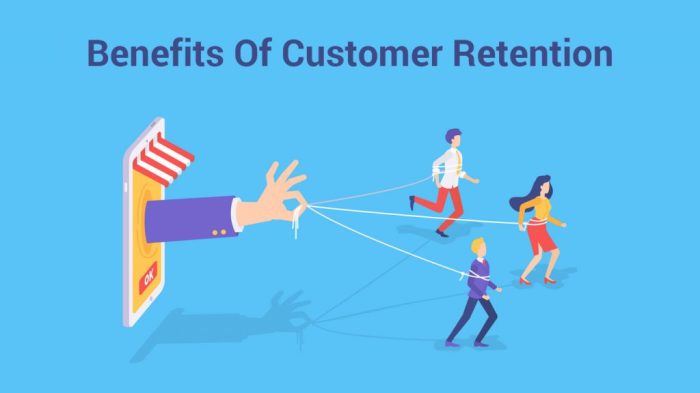
Understanding and tracking customer retention is crucial for sustainable business growth. Effective measurement provides insights into the health of your customer base and allows for proactive adjustments to improve retention strategies. By analyzing key metrics, businesses can identify areas of strength and weakness, ultimately leading to improved profitability and long-term success.
Customer Churn Rate
Customer churn rate represents the percentage of customers a business loses over a specific period. A high churn rate indicates a problem with customer satisfaction or product/service offerings. Lowering churn is a key focus for most businesses, as retaining existing customers is often more cost-effective than acquiring new ones. Calculating churn rate allows businesses to monitor their progress in this area and make data-driven decisions.
The formula for calculating churn rate is: Churn Rate = (Number of Customers Lost during a Period / Number of Customers at the Beginning of the Period) x 100
For example, if a company started with 1000 customers and lost 100 during the month, the churn rate would be (100/1000) x 100 = 10%. This indicates a 10% customer loss during that month. Analyzing this metric month-over-month helps identify trends and potential issues.
Customer Lifetime Value (CLTV)
Customer Lifetime Value (CLTV) predicts the total revenue a business expects to generate from a single customer over their entire relationship with the company. Understanding CLTV helps businesses prioritize high-value customers and tailor strategies to maximize their contribution. A higher CLTV signifies a more profitable customer base. Companies can use this metric to assess the return on investment (ROI) of different customer acquisition and retention initiatives.Several methods exist for calculating CLTV, with varying levels of complexity.
A simplified approach might involve estimating the average purchase value, purchase frequency, and average customer lifespan. For example, if a customer spends an average of $100 per month, purchases every month, and remains a customer for 2 years (24 months), their CLTV would be $100/month24 months = $2400. More sophisticated models incorporate factors like customer segmentation and churn rate for a more accurate prediction.
Customer Retention Rate
The customer retention rate directly measures the percentage of customers a business retains over a specific period. This metric provides a clear picture of how well a business is holding onto its customer base. A high retention rate usually indicates strong customer satisfaction and loyalty. It’s calculated as the opposite of the churn rate.
The formula for calculating customer retention rate is: Retention Rate = 100%
Churn Rate
Using the previous example of a 10% churn rate, the customer retention rate would be 100%10% = 90%. This signifies that the company retained 90% of its customers during that period. Monitoring this metric helps track the effectiveness of retention strategies and identify areas needing improvement.
Analyzing Customer Retention Data
Analyzing customer retention data involves more than just calculating rates; it requires a deeper understanding ofwhy* customers leave. This often involves examining customer feedback through surveys, reviews, and support interactions. Identifying common themes or pain points can reveal areas for improvement in products, services, or customer support. Analyzing data segmented by customer demographics, purchase history, or other relevant factors can provide more granular insights.
This targeted approach enables the development of more effective retention strategies. For instance, if a company notices high churn among a specific demographic, they can tailor their marketing or product offerings to better address that group’s needs. Regular monitoring and analysis are key to continuously improving customer retention.
Customer Service and Customer Retention
Exceptional customer service is the cornerstone of successful customer retention. It’s not merely about resolving issues; it’s about building lasting relationships that foster loyalty and advocacy. A positive customer experience directly translates into increased retention rates, repeat business, and positive word-of-mouth marketing.Proactive and reactive customer service approaches, while both vital, differ significantly in their impact on retention. Reactive service addresses problemsafter* they arise, while proactive service anticipates and prevents issues before they occur.
Both are crucial for a comprehensive customer service strategy.
Proactive versus Reactive Customer Service
Reactive customer service focuses on addressing customer complaints and resolving issues as they occur. This approach is essential for damage control and maintaining a positive reputation, but it’s inherently reactive. For example, responding to a negative online review or addressing a product defect falls under reactive service. While necessary, it doesn’t build loyalty as effectively as proactive measures.In contrast, proactive customer service aims to anticipate and prevent problems.
This might involve personalized recommendations, regular check-ins with high-value customers, or proactive communication about potential service disruptions. A proactive approach, such as sending a follow-up email after a purchase to ensure customer satisfaction or offering helpful tutorials, demonstrates a commitment to customer success and fosters stronger relationships. This often leads to higher retention rates compared to a solely reactive approach.
Proactive service builds trust and loyalty by demonstrating care and anticipating needs before problems arise.
Building Strong Customer Relationships Through Consistent Communication
Consistent and meaningful communication is paramount in building strong customer relationships. This goes beyond simply responding to inquiries; it involves actively engaging with customers throughout their journey. Regular newsletters, personalized email campaigns, and targeted social media interactions can all contribute to a sense of connection and build brand loyalty. For instance, a company might send personalized birthday emails or exclusive offers to reward loyal customers, reinforcing their value and fostering a sense of community.
Regular, relevant communication keeps the brand top-of-mind and encourages repeat business.
Utilizing Various Customer Service Channels
Offering diverse customer service channels caters to different customer preferences and enhances accessibility. Email remains a popular choice for non-urgent inquiries, while phone support provides immediate assistance for urgent issues. Social media platforms offer a public forum for interaction and addressing concerns quickly. Live chat provides instant support on websites, offering a convenient and immediate response mechanism. Each channel serves a specific purpose, and offering a combination ensures customers can choose the method most comfortable and efficient for them.
A multi-channel approach allows businesses to be responsive and cater to individual customer needs.
Key Elements of a Successful Customer Service Training Program
A well-structured training program is critical for equipping customer service representatives with the skills and knowledge to excel. The key elements include:
- Product Knowledge: Thorough understanding of products/services offered.
- Communication Skills: Active listening, clear articulation, empathy, and conflict resolution.
- Technical Skills: Proficiency in using CRM software, ticketing systems, and relevant technologies.
- Company Policies and Procedures: In-depth knowledge of return policies, warranties, and internal processes.
- Problem-Solving and Decision-Making: Ability to analyze situations, identify solutions, and make informed decisions.
- Customer Relationship Management (CRM): Effective use of CRM systems for tracking interactions and managing customer data.
- Continuous Learning and Development: Ongoing training and updates on new products, services, and best practices.
Case Studies
Understanding successful customer retention strategies requires examining real-world examples. The following case studies illustrate how different companies across various industries have implemented effective programs, highlighting the key factors behind their success. Analyzing these examples provides valuable insights for businesses looking to improve their own customer retention efforts.
Amazon’s Customer-Centric Approach
Amazon’s phenomenal success is largely attributed to its unwavering focus on customer experience. Their customer retention strategies are multifaceted, encompassing seamless online shopping, personalized recommendations, proactive customer service (including easy returns and refunds), and a vast selection of products. They leverage data analytics to understand customer behavior and preferences, allowing for highly targeted marketing and personalized recommendations. This approach fosters loyalty by making the shopping experience convenient and enjoyable.
Amazon’s investment in robust logistics and delivery systems also contributes significantly to customer satisfaction and retention. Their Prime membership program offers additional benefits, further incentivizing customer loyalty.
Starbucks’ Rewards Program
Starbucks’ loyalty program is a prime example of a successful customer retention strategy in the food and beverage industry. The program rewards customers with points for every purchase, which can be redeemed for free drinks or food. Beyond the points system, Starbucks cultivates a sense of community through its in-store experience and personalized interactions with baristas. This combination of rewards and personalized engagement significantly increases customer loyalty and repeat business.
The program also utilizes mobile ordering and payment, streamlining the customer journey and enhancing convenience.
Apple’s Ecosystem and Brand Loyalty
Apple’s success stems from a combination of factors, including high-quality products, a seamless user experience across its devices, and a strong brand identity. The company cultivates a loyal customer base through its integrated ecosystem, where devices and software work seamlessly together. This encourages customers to remain within the Apple ecosystem, increasing their lifetime value. Apple also invests heavily in customer service and support, ensuring customers have a positive experience even after purchasing a product.
Their retail stores act as community hubs, fostering a sense of belonging and brand loyalty.
| Company | Strategies Used | Results Achieved | Lessons Learned |
|---|---|---|---|
| Amazon | Seamless online shopping, personalized recommendations, proactive customer service, Prime membership program, data-driven marketing | High customer lifetime value, strong brand loyalty, market dominance | Prioritizing customer experience is crucial, data-driven personalization is key, investment in logistics and technology pays off |
| Starbucks | Rewards program, personalized interactions, community building, mobile ordering | Increased customer frequency, higher average transaction value, strong brand loyalty | Loyalty programs drive repeat business, personalized engagement fosters loyalty, convenience is key |
| Apple | Integrated ecosystem, high-quality products, strong brand identity, excellent customer service, retail store experience | High customer lifetime value, strong brand loyalty, premium pricing power | Building a strong brand and ecosystem is crucial, consistent customer experience is essential, investing in customer service pays off |
The Future of Customer Retention
The landscape of customer retention is constantly evolving, driven by technological advancements and shifting consumer expectations. Understanding these changes is crucial for businesses aiming to maintain a competitive edge and foster long-term growth. Successfully navigating this evolving landscape requires a proactive approach, embracing innovation and adapting strategies to meet the demands of a dynamic marketplace.The increasing sophistication of data analytics, the rise of AI-powered personalization, and the expanding influence of social media are reshaping how businesses interact with and retain customers.
Simultaneously, challenges such as increasing competition, economic uncertainty, and evolving customer preferences demand agile and adaptable strategies.
Emerging Trends and Technologies
Several key trends are significantly impacting customer retention strategies. Artificial intelligence (AI) is playing a pivotal role in personalizing customer experiences through targeted marketing campaigns and proactive customer service. Machine learning algorithms analyze vast amounts of customer data to predict churn risk and identify opportunities for improvement. For example, Netflix uses AI to recommend shows and movies based on individual viewing history, significantly increasing user engagement and retention.
Similarly, predictive analytics enables businesses to anticipate customer needs and address potential issues before they escalate, preventing churn. Another significant trend is the increasing importance of omnichannel customer experiences. Customers expect seamless interactions across various touchpoints, including websites, mobile apps, social media, and physical stores. Businesses that can successfully integrate these channels and provide a consistent brand experience are better positioned to retain customers.
Potential Challenges to Maintaining Customer Loyalty
Maintaining customer loyalty in the future presents several significant challenges. The rise of subscription services has increased competition, forcing businesses to constantly innovate and offer superior value propositions. Economic uncertainty can also impact customer spending habits, leading to increased price sensitivity and a greater emphasis on value for money. Furthermore, evolving customer expectations require businesses to be adaptable and responsive to changing preferences.
Customers are increasingly demanding personalized experiences, seamless interactions, and transparent communication. Failing to meet these expectations can lead to customer dissatisfaction and churn. For instance, a sudden change in a subscription service’s pricing or terms without adequate notice can lead to a significant drop in customer retention.
Predictions for the Evolution of Customer Retention Strategies
Over the next five years, we can expect to see a continued emphasis on personalization and proactive customer service. AI and machine learning will play an increasingly important role in predicting customer behavior and tailoring experiences to individual needs. The use of predictive analytics will become more sophisticated, enabling businesses to anticipate and address potential issues before they impact customer loyalty.
Furthermore, the integration of emerging technologies such as the metaverse and Web3 will present new opportunities for businesses to engage with customers in innovative ways. For example, brands could create immersive experiences within the metaverse to build stronger customer relationships and foster loyalty. However, the success of these strategies will depend on the ability of businesses to address the challenges of data privacy, security, and ethical considerations associated with the use of advanced technologies.
We predict that companies who successfully blend advanced technology with a human-centric approach to customer service will be the most successful at customer retention.
Ultimately, prioritizing customer retention isn’t just about boosting profits; it’s about cultivating genuine relationships. By focusing on providing exceptional experiences, actively soliciting feedback, and adapting to evolving customer needs, businesses can build a loyal customer base that drives sustainable growth and fosters long-term brand advocacy. The journey towards achieving superior customer retention demands consistent effort, strategic planning, and a genuine commitment to customer satisfaction.
The rewards, however, are immeasurable, solidifying a business’s position in the market and paving the way for lasting success.
Common Queries
What is the difference between customer acquisition and retention?
Customer acquisition focuses on attracting new customers, while retention centers on keeping existing customers. Acquisition is typically more expensive and resource-intensive.
How can I measure the effectiveness of my customer retention efforts?
Key metrics include customer churn rate, customer lifetime value (CLTV), and Net Promoter Score (NPS). Tracking these metrics provides valuable insights into retention performance.
What role does technology play in improving customer retention?
Technology enables personalized experiences through data analytics, automated communication, and improved customer service channels (e.g., chatbots, CRM systems).
How can small businesses effectively implement customer retention strategies?
Small businesses can focus on building personal relationships, providing exceptional customer service, and utilizing cost-effective tools for communication and feedback collection.


