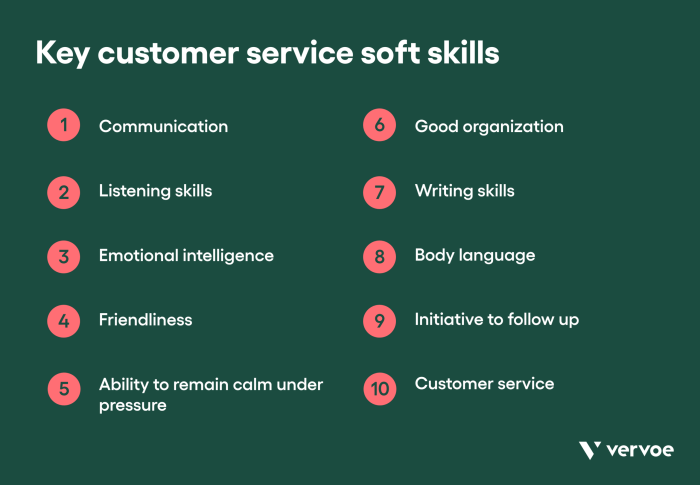
Effective customer service communication is the cornerstone of any successful business. It’s more than just resolving issues; it’s about building relationships, fostering loyalty, and ultimately driving revenue. This exploration delves into the multifaceted aspects of excellent communication in customer service, examining strategies, techniques, and best practices to elevate your interactions and create a positive customer experience.
From understanding the nuances of various communication channels to mastering active listening and empathy, we’ll cover essential skills for handling even the most challenging situations. We will also explore how to measure and improve communication effectiveness, ensuring continuous growth and customer satisfaction.
Active Listening and Empathy in Customer Interactions
Effective communication is the cornerstone of excellent customer service. Building strong rapport and resolving conflicts efficiently hinges on the ability to actively listen and demonstrate empathy. These skills not only diffuse tense situations but also foster loyalty and positive customer experiences.Active listening goes beyond simply hearing what a customer says; it involves fully understanding their perspective, concerns, and emotions.
This approach creates a safe space for open communication, allowing customers to feel heard and valued. Employing empathy allows you to connect with the customer on a human level, fostering trust and improving the overall interaction.
The Role of Active Listening in Rapport Building
Active listening is crucial for building rapport because it demonstrates genuine interest and respect for the customer. By giving your undivided attention, making eye contact (or the equivalent in virtual interactions), and using verbal and nonverbal cues to show engagement, you create a connection that fosters trust. This, in turn, makes the customer more receptive to your solutions and more likely to have a positive experience.
Customers who feel heard are more likely to remain loyal. For example, nodding your head, mirroring body language (appropriately), and using verbal affirmations like “I understand” can significantly improve rapport.
Demonstrating Empathy in Challenging Situations
Handling challenging customer service situations requires a high degree of empathy. Empathy is the ability to understand and share the feelings of another. In challenging situations, this means acknowledging the customer’s frustration, validating their emotions, and showing that you care about their experience. Even if you disagree with the customer’s perspective, acknowledging their feelings can significantly de-escalate the situation.
For example, a phrase like, “I can understand why you’re frustrated by this,” can go a long way in diffusing anger. Focusing on the customer’s emotional state, rather than immediately jumping to solutions, helps to build trust and cooperation.
Paraphrasing and Reflecting Customer Concerns
Paraphrasing and reflecting customer concerns are key techniques for demonstrating understanding. Paraphrasing involves restating the customer’s concerns in your own words to ensure you understand them correctly. Reflecting involves summarizing the customer’s emotions and feelings. For example, if a customer says, “This is unacceptable! I’ve been waiting for this order for weeks,” you could paraphrase by saying, “So, you’re extremely frustrated because your order is significantly overdue.” Then you could reflect their emotion by adding, “I can see how upsetting this must be.” This shows the customer that you’re paying attention and truly understand their situation.
Handling Difficult Customer Interactions
A step-by-step guide to handling difficult customer interactions using active listening and empathy:
- Listen attentively: Give the customer your full attention without interrupting. Use nonverbal cues to show you’re engaged.
- Acknowledge their feelings: Validate the customer’s emotions, even if you don’t agree with their perspective. Use phrases like, “I understand your frustration,” or “I can see why you’re upset.”
- Paraphrase and reflect: Restate the customer’s concerns in your own words to confirm your understanding and show empathy.
- Apologize sincerely: If appropriate, offer a sincere apology, even if you’re not personally responsible for the problem. This shows you care about the customer’s experience.
- Find a solution: Work collaboratively with the customer to find a mutually acceptable solution. Involve them in the process to foster a sense of ownership and control.
- Follow up: After resolving the issue, follow up with the customer to ensure they’re satisfied and to prevent future problems.
Nonverbal Communication in Customer Service
Effective communication in customer service isn’t solely about the words you speak; it’s significantly influenced by nonverbal cues. These unspoken signals—body language, tone of voice, facial expressions—often speak louder than words, shaping customer perceptions and influencing the overall interaction. Mastering nonverbal communication is crucial for building rapport, resolving conflicts, and ultimately, delivering exceptional customer service.Nonverbal cues profoundly impact how customers perceive your message and your company.
A warm smile and welcoming posture can instantly put a customer at ease, fostering trust and a positive interaction. Conversely, a slumped posture, crossed arms, or a dismissive tone can create distance and convey disinterest, leading to frustration and negative feelings. The impact of nonverbal communication is immediate and powerful, often shaping the customer’s experience more than the specific words used.
The Impact of Nonverbal Cues on Customer Perceptions
Nonverbal communication encompasses a wide range of cues, each with the potential to significantly influence customer perception. Tone of voice, for example, can convey enthusiasm, empathy, or impatience. A monotone voice can sound disinterested, while a hurried tone might suggest a lack of time or care. Body language, including posture, gestures, and facial expressions, plays an equally crucial role.
A confident, open posture with appropriate hand gestures can project professionalism and engagement. Conversely, fidgeting, avoiding eye contact, or displaying closed-off body language can create a sense of distrust or disengagement. Facial expressions also directly communicate emotions; a genuine smile conveys warmth and approachability, while a frown or a forced smile can be easily perceived as insincere. The cumulative effect of these nonverbal cues significantly shapes the customer’s overall experience.
Examples of Enhancing and Hindering Customer Interactions
Positive nonverbal communication enhances customer interactions by building rapport and trust. Imagine a customer service representative who maintains consistent eye contact, uses a warm and reassuring tone of voice, and smiles genuinely. This nonverbal communication immediately establishes a connection, creating a comfortable and supportive environment for the customer to express their concerns. In contrast, consider a representative who avoids eye contact, speaks in a monotone voice, and displays a bored or impatient demeanor.
This negative nonverbal communication can create distance and escalate the customer’s frustration, leading to a negative experience. A simple example of a positive nonverbal cue would be leaning slightly forward during a conversation to show engagement and active listening. Conversely, looking away or checking a phone while the customer is speaking is a clear indication of disinterest and disrespect.
Maintaining a Professional and Positive Demeanor
Maintaining a professional and positive demeanor is paramount in customer service. This involves consciously controlling your nonverbal cues to project confidence, empathy, and professionalism. A professional demeanor is not merely about appearance; it encompasses the entire range of nonverbal communication. This includes maintaining appropriate eye contact, adopting a relaxed yet attentive posture, and using clear and concise language with a consistently positive tone of voice.
A positive demeanor, in turn, builds rapport, diffuses tense situations, and ultimately, creates a more positive and productive interaction. Remember, even when dealing with difficult customers, maintaining a calm and professional demeanor can de-escalate the situation and improve the overall outcome.
Checklist for Effective Nonverbal Communication
Before each customer interaction, take a moment to consider your nonverbal communication. A simple checklist can help ensure you project the right image and create a positive experience.
- Maintain appropriate eye contact: This shows engagement and respect.
- Use open and welcoming body language: Uncross your arms and maintain a relaxed yet attentive posture.
- Smile genuinely: A genuine smile conveys warmth and approachability.
- Use a clear and positive tone of voice: Avoid monotone or hurried speech.
- Mirror customer’s body language subtly: This can build rapport and create a sense of connection (use cautiously and naturally).
- Minimize distracting behaviors: Avoid fidgeting, checking your phone, or interrupting the customer.
- Pay attention to your personal appearance: Dress professionally and maintain good hygiene.
Handling Complaints and Difficult Customers
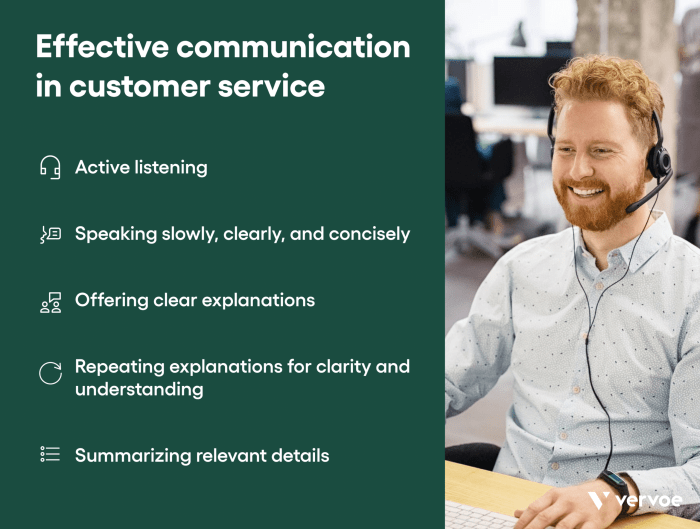
Effective complaint handling is crucial for customer retention and business success. Addressing customer concerns promptly and professionally can transform a negative experience into a positive one, strengthening the customer relationship and fostering brand loyalty. Conversely, mishandling complaints can lead to negative reviews, loss of business, and damage to reputation. This section Artikels strategies for effectively managing complaints and difficult customer interactions.
De-escalating tense situations and resolving conflicts requires a calm, empathetic, and solution-oriented approach. Active listening, validating the customer’s feelings, and demonstrating a genuine desire to help are paramount. The goal is not to win an argument, but to find a mutually acceptable resolution.
Strategies for De-escalating Tense Situations
Effective de-escalation involves understanding the customer’s emotional state and responding appropriately. This requires patience, active listening, and a willingness to understand their perspective, even if you don’t necessarily agree with it. Employing calming techniques, such as speaking slowly and clearly, using a calm and reassuring tone, and mirroring the customer’s body language (to a degree) can help reduce tension.
Offering sincere apologies, even if you don’t believe the company is entirely at fault, can also go a long way in diffusing anger. Acknowledging the customer’s frustration and validating their feelings (“I understand your frustration, this is certainly not the experience we want for our customers.”) can significantly improve the interaction.
Methods for Handling Customer Complaints and Resolving Conflicts
A structured approach to handling complaints is essential for consistency and efficiency. This involves actively listening to the complaint, summarizing the issue to ensure understanding, expressing empathy, and outlining potential solutions. Collaboratively working towards a resolution that meets the customer’s needs is key. This might involve offering a refund, replacement, discount, or other form of compensation. If the issue requires further investigation, setting clear expectations about timelines and follow-up is crucial.
Maintaining a professional and respectful demeanor throughout the process is vital, even when faced with aggressive or abusive behavior. Remember to document the entire interaction meticulously.
Examples of Scripts for Addressing Common Customer Complaints
While there’s no one-size-fits-all script, having a framework can be helpful. For example, a common complaint might be about a delayed delivery. A possible response could be: “I understand your frustration about the delayed delivery. I sincerely apologize for the inconvenience this has caused. Let me check the status of your order immediately.
[Pause to check order status]. It appears there was a slight delay due to [reason for delay]. We expect it to arrive by [new delivery date]. As a gesture of our apology, I’d like to offer you [discount or other compensation].” For a faulty product complaint, a similar structure can be used, focusing on offering a repair, replacement, or refund, depending on the situation and company policy.
Steps for Documenting and Tracking Customer Complaints
Thorough documentation is essential for identifying trends, improving processes, and preventing future issues. Each complaint should be recorded with details including the customer’s name, contact information, date and time of the complaint, a summary of the issue, the actions taken, the resolution, and the outcome. A centralized system, such as a CRM (Customer Relationship Management) software or a dedicated spreadsheet, should be used to track complaints.
Regularly reviewing these records can highlight areas for improvement in products, services, or processes. This data can inform training programs, policy changes, and process improvements to prevent similar issues from recurring.
Measuring and Improving Customer Service Communication
Effective communication is the cornerstone of excellent customer service. Understanding how well your team communicates and identifying areas for improvement is crucial for enhancing customer satisfaction and loyalty. Regularly measuring and analyzing communication effectiveness allows for proactive adjustments, ultimately leading to a more positive customer experience.
Measuring and improving customer service communication involves a systematic approach encompassing feedback collection, analysis, KPI implementation, and action planning. This iterative process ensures continuous improvement and adaptation to evolving customer needs and expectations.
Collecting Customer Feedback on Communication Effectiveness
Several methods can be employed to gather valuable feedback on the effectiveness of customer service communication. These methods provide a comprehensive view of customer perceptions and highlight areas requiring attention. A multi-faceted approach, combining quantitative and qualitative data, provides the most robust insights.
Effective feedback collection strategies are essential for understanding customer perceptions and identifying areas for improvement in customer service communication. Utilizing diverse methods ensures a comprehensive understanding and reduces reliance on single data points.
- Customer Surveys: Post-interaction surveys (email or online) can directly ask customers to rate aspects of the communication, such as clarity, helpfulness, and politeness. Open-ended questions allow for more detailed feedback.
- Feedback Forms: Physical or online forms provide a structured way for customers to provide feedback on specific interactions or overall service experiences. These forms often include rating scales and open text fields for comments.
- Social Media Monitoring: Actively monitoring social media platforms for mentions of your brand allows you to identify both positive and negative comments regarding customer service interactions. This offers valuable, real-time insights.
- Customer Interviews: Conducting brief interviews with customers can provide in-depth qualitative data. This approach allows for a deeper understanding of customer perspectives and the nuances of their experiences.
Analyzing Customer Feedback to Identify Areas for Improvement
Once feedback is collected, it needs to be systematically analyzed to pinpoint areas needing improvement. This analysis should focus on identifying trends and patterns in customer responses.
Careful analysis of collected feedback is crucial for translating raw data into actionable insights. Identifying recurring themes and patterns helps prioritize areas for improvement and resource allocation.
- Qualitative Data Analysis: Thematic analysis of open-ended responses from surveys and interviews can reveal underlying issues and customer concerns related to communication style, tone, or information clarity.
- Quantitative Data Analysis: Analyzing numerical data from surveys and feedback forms allows for the identification of specific areas where customer satisfaction scores are low. This provides a clear indication of which aspects of communication need attention.
- Sentiment Analysis: Using sentiment analysis tools on social media comments and customer reviews can quickly identify the overall positive or negative sentiment towards customer service communication. This allows for a rapid assessment of the overall effectiveness of communication strategies.
Key Performance Indicators (KPIs) for Measuring Customer Service Communication Success
KPIs provide measurable metrics to track the effectiveness of customer service communication strategies. These indicators should align with overall business goals and customer satisfaction targets.
KPIs offer quantifiable measures of customer service communication effectiveness, allowing for objective assessment and informed decision-making. Regular monitoring of these metrics ensures continuous improvement and alignment with business objectives.
- Customer Satisfaction (CSAT) Score: Measures overall customer satisfaction with the communication received during a service interaction.
- Net Promoter Score (NPS): Gauges customer loyalty and willingness to recommend the company based on their communication experience.
- Average Handling Time (AHT): Tracks the average time spent resolving customer issues, indicating efficiency in communication.
- First Call Resolution (FCR): Measures the percentage of customer issues resolved on the first contact, reflecting effective and clear communication.
- Customer Effort Score (CES): Assesses the ease with which customers can resolve their issues, reflecting the simplicity and clarity of communication.
Implementing Changes Based on Customer Feedback and Performance Data
Based on the analysis of feedback and KPI data, a comprehensive plan for improvement should be developed and implemented. This plan should include specific, measurable, achievable, relevant, and time-bound (SMART) goals.
A well-defined action plan is essential for translating insights from feedback and KPI data into tangible improvements in customer service communication. This plan should Artikel specific steps, timelines, and responsibilities to ensure effective implementation.
- Training Programs: Develop and implement training programs to address identified communication weaknesses, focusing on areas such as active listening, empathy, and clear articulation.
- Process Improvements: Streamline processes to reduce handling times and improve first call resolution rates. This might involve implementing new technologies or improving internal communication workflows.
- Technology Upgrades: Invest in new technologies, such as CRM systems or live chat software, to improve communication efficiency and effectiveness.
- Regular Monitoring and Review: Continuously monitor KPIs and collect customer feedback to track progress and make adjustments to the improvement plan as needed. This iterative approach ensures ongoing optimization.
CUSTOMER SERVICE & CUSTOMER RETENTION
Effective communication is the cornerstone of successful customer service, directly impacting customer retention rates and fostering loyalty. A positive customer experience, built on clear, empathetic, and efficient communication, significantly increases the likelihood of repeat business and positive word-of-mouth referrals. Conversely, poor communication can quickly erode trust and lead to customer churn.Excellent customer service communication and customer retention are intrinsically linked.
The ability to effectively understand and address customer needs, resolve issues promptly, and build rapport through consistent and professional communication creates a strong foundation for long-term relationships. This, in turn, translates into higher retention rates, reduced customer acquisition costs, and increased profitability.
The Correlation Between Effective Communication and Customer Retention
Strong communication skills directly contribute to higher customer retention. When customers feel heard, understood, and valued, they are more likely to remain loyal to a business. This includes prompt responses to inquiries, clear explanations of products or services, and efficient resolution of problems. Companies that prioritize clear and concise communication often see significantly higher retention rates compared to those that struggle in this area.
For example, a study by [insert reputable source and statistics if available] showed a direct correlation between positive customer service interactions and customer lifetime value. The better the communication, the longer the customer stays and the more they spend.
Excellent Communication and Increased Customer Loyalty and Advocacy
Excellent communication fosters loyalty by creating a sense of trust and personalized attention. Customers who feel valued and understood are more likely to become loyal advocates, recommending the company to others and acting as brand ambassadors. This positive word-of-mouth marketing is invaluable and significantly more effective than traditional advertising. For instance, a company known for its exceptional customer service, such as [insert example of a company known for great customer service], benefits from a high volume of referrals driven by satisfied customers who actively promote the brand to their networks.
This loyalty translates into increased sales and long-term growth.
Examples of Companies Using Communication to Build Strong Customer Relationships
Many companies utilize various communication strategies to build strong customer relationships. For example, companies like Zappos are renowned for their exceptional customer service, offering extended return windows and highly personalized interactions. Their focus on building rapport and going the extra mile fosters customer loyalty. Similarly, companies like Apple utilize a multi-channel approach, combining in-store support, online resources, and social media engagement to maintain consistent communication and address customer needs effectively.
This proactive approach strengthens the customer relationship and promotes brand loyalty.
A Customer Retention Strategy Emphasizing Proactive and Personalized Communication
A proactive and personalized communication strategy is crucial for effective customer retention. This strategy should incorporate several key elements:
First, implement a robust customer relationship management (CRM) system to track customer interactions and preferences. This allows for personalized communications tailored to individual needs and purchase history. Second, utilize multiple communication channels, such as email, SMS, social media, and in-app messaging, to reach customers where they are most comfortable. Third, proactively engage with customers through targeted email campaigns, personalized offers, and loyalty programs.
Fourth, actively solicit feedback through surveys and reviews to understand customer needs and identify areas for improvement. Finally, empower customer service representatives to resolve issues efficiently and empathetically, ensuring a positive experience at every touchpoint. This multi-faceted approach creates a personalized and engaging experience, encouraging customer loyalty and retention.
Mastering customer service communication skills is an ongoing journey, requiring continuous learning and adaptation. By implementing the strategies and techniques discussed, businesses can transform their customer interactions, cultivate lasting relationships, and achieve sustainable growth. Remember, every interaction is an opportunity to build brand loyalty and solidify your reputation for exceptional service.
FAQ Summary
What are some common communication barriers in customer service?
Common barriers include language differences, unclear expectations, technological glitches, and emotional responses from either the customer or the service representative.
How can I improve my tone of voice in customer service interactions?
Practice speaking clearly and calmly, using a friendly and respectful tone. Avoid using jargon or overly technical language. Actively listen to the customer to gauge their emotional state and adjust your tone accordingly.
How do I handle a customer who is being abusive or disrespectful?
Remain calm and professional. Acknowledge their frustration, but set clear boundaries. If the behavior continues, disengage politely and escalate the issue to a supervisor.
What are some effective ways to apologize to a customer?
Offer a sincere apology, acknowledging their experience and taking responsibility (where appropriate). Avoid making excuses and focus on finding a solution to their problem.


