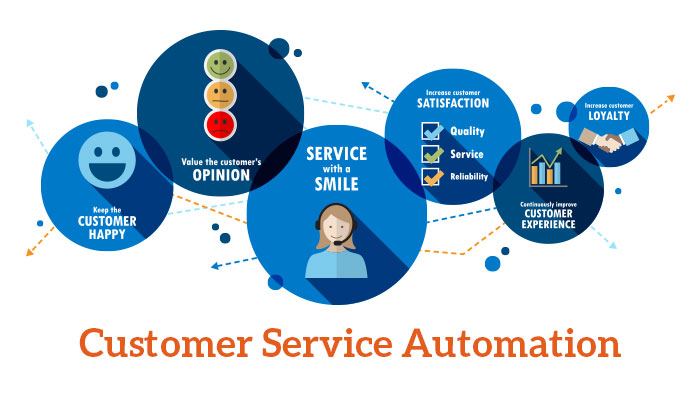
In today’s fast-paced business environment, efficient customer service is paramount. Customer Service Automation Tools (CSAT) have emerged as a crucial element in achieving this efficiency, transforming how businesses interact with their clientele. From simple email automation to sophisticated AI-powered chatbots, these tools offer a wide array of solutions to enhance responsiveness, personalize interactions, and ultimately, boost customer satisfaction and retention.
This exploration delves into the multifaceted world of CSAT, examining their various types, implementation strategies, and the profound impact they have on modern business operations.
This examination covers the evolution of CSAT, highlighting the shift from rudimentary systems to the sophisticated, AI-driven solutions available today. We will analyze the diverse functionalities of different tools, including chatbots, Interactive Voice Response (IVR) systems, and email automation platforms. Furthermore, we’ll discuss the strategic integration of these tools into existing CRM systems, optimizing workflows and maximizing their effectiveness across various business sizes and industries.
Introduction to Customer Service Automation Tools
Customer service automation has revolutionized how businesses interact with their customers, transitioning from primarily human-driven interactions to a more efficient and scalable model leveraging technology. This evolution has been driven by increasing customer expectations for immediate responses and personalized experiences, coupled with the need for businesses to optimize operational costs and improve agent productivity. The shift towards automation has been gradual, starting with simple tools like automated email responses and progressing to sophisticated AI-powered chatbots and virtual assistants.The implementation of customer service automation tools offers significant advantages across various business sizes.
Smaller businesses can leverage these tools to level the playing field, providing responsive service comparable to larger corporations. Larger enterprises benefit from enhanced scalability and the ability to handle exponentially increasing customer volumes without significant increases in staffing costs. Ultimately, automation allows businesses of all sizes to focus resources on complex customer issues requiring human intervention, while handling routine inquiries efficiently and effectively.
Types of Customer Service Automation Tools
Several categories of tools exist within the customer service automation landscape. These tools address different aspects of customer interaction, from initial contact to post-interaction follow-up. Understanding the various options available allows businesses to select the most appropriate solutions for their specific needs and resources.
Examples of Customer Service Automation Tools
The market offers a wide range of customer service automation tools, each with its unique features and capabilities. Examples include live chat software, such as Intercom or Zendesk Chat, which provide real-time support and immediate responses to customer queries. AI-powered chatbots, like those offered by Dialogflow or Amazon Lex, can handle more complex interactions, guiding customers through self-service options or escalating issues to human agents as needed.
Help desk software, such as Freshdesk or Jira Service Desk, streamline the ticketing process, providing organized tracking and resolution of customer issues. Finally, robotic process automation (RPA) tools can automate repetitive tasks, freeing up human agents to focus on more strategic activities. The choice of specific tools depends heavily on a company’s size, budget, and existing infrastructure.
Benefits of Implementing Customer Service Automation Tools
The benefits of implementing customer service automation tools are multifaceted. Improved customer satisfaction is a key advantage, as automated systems can provide instant responses and personalized experiences, leading to increased customer loyalty. Automation also significantly enhances operational efficiency, reducing response times and freeing up human agents to focus on more complex issues. This translates to cost savings, as businesses can handle higher volumes of inquiries with fewer agents.
Further, data-driven insights are generated through automation, allowing businesses to analyze customer interactions, identify trends, and continuously improve their service offerings. These improvements in efficiency and customer satisfaction ultimately contribute to increased revenue and improved brand reputation.
Types of Customer Service Automation Tools
Customer service automation tools come in various forms, each designed to handle specific aspects of customer interaction and support. Choosing the right tools depends heavily on a business’s size, industry, and customer base. Understanding the different types and their capabilities is crucial for effective implementation.
These tools can be broadly categorized based on their primary function, allowing businesses to tailor their approach to specific customer needs and communication preferences. Effective integration with existing systems is also a key consideration, ensuring seamless data flow and a unified customer view.
Chatbots
Chatbots are arguably the most recognizable form of customer service automation. These AI-powered programs engage with customers through text-based interfaces, often integrated into websites or messaging apps. Sophisticated chatbots can handle a wide range of inquiries, from simple FAQs to more complex troubleshooting, using natural language processing (NLP) and machine learning (ML) to understand and respond to customer requests.
Features include 24/7 availability, personalized interactions based on customer data, and the ability to escalate complex issues to human agents. Integration with CRM systems allows chatbots to access customer history and preferences, providing a more contextual and personalized experience. For example, a chatbot integrated with a CRM might greet a returning customer by name and access their past purchase history to offer relevant product recommendations or address past issues proactively.
Interactive Voice Response (IVR) Systems
IVR systems are automated phone systems that guide callers through a series of menu options to reach the appropriate department or agent. These systems use voice recognition and text-to-speech technology to interact with callers, offering self-service options and reducing the workload on human agents. Basic IVRs offer simple menu navigation, while more advanced systems can handle complex requests, understand natural language, and even offer personalized greetings based on caller identification.
Integration with CRM systems allows IVRs to access caller information, providing agents with relevant context when a call is transferred to a human representative. A common example is a bank’s IVR system, which allows customers to check account balances, transfer funds, or report lost cards without speaking to an agent.
Email Automation
Email automation tools streamline the process of sending and managing customer emails. These tools can automate tasks such as sending welcome emails, order confirmations, shipping updates, and follow-up messages. More advanced systems can personalize emails based on customer data and segment customers into groups for targeted messaging. Features include automated email responses, triggered emails based on specific customer actions (e.g., cart abandonment), and email campaign management.
Integration with CRM systems enables email automation tools to personalize emails with customer-specific information and track email open and click-through rates, providing valuable insights into customer engagement. For instance, an e-commerce company might use email automation to send personalized product recommendations based on a customer’s browsing history or past purchases.
Knowledge Base and Help Desk Software
These tools provide a centralized repository of information for customers and agents. Customers can access self-service resources, such as FAQs, tutorials, and troubleshooting guides, while agents can use the knowledge base to quickly find answers to customer questions. Help desk software further enhances this functionality by providing a system for managing and tracking customer support tickets, ensuring that issues are resolved efficiently.
Integration with CRM systems allows for a unified view of customer interactions, enabling agents to access relevant information from the knowledge base and help desk system when interacting with customers. This integrated approach streamlines support and improves the overall customer experience. A well-known example is Zendesk, which offers a suite of tools for managing customer support, including a knowledge base and help desk software.
The Future of Customer Service Automation
The rapid advancement of artificial intelligence (AI) and machine learning (ML) is poised to revolutionize customer service automation, leading to more efficient, personalized, and proactive interactions. We’re moving beyond simple chatbots to sophisticated systems capable of understanding nuanced language, anticipating customer needs, and even resolving complex issues autonomously. This evolution will significantly impact both customer experience and business operations.The integration of AI and ML will drive several key changes.
AI-powered tools will become increasingly adept at handling a wider range of customer inquiries, freeing up human agents to focus on more complex and emotionally demanding tasks. This shift will not only increase efficiency but also improve the overall quality of customer service.
Enhanced Personalization Through AI
AI algorithms can analyze vast amounts of customer data – purchase history, browsing behavior, past interactions – to create highly personalized experiences. This means tailored product recommendations, proactive problem-solving, and customized communication styles, all contributing to increased customer satisfaction and loyalty. For example, an e-commerce platform might use AI to suggest products relevant to a customer’s recent browsing activity, or a banking app could proactively alert a customer to potential fraudulent activity based on their transaction patterns.
This level of personalization is simply not achievable with traditional customer service methods.
Predictive Analytics and Proactive Service
Predictive analytics, powered by machine learning, allows businesses to anticipate customer needs and proactively address potential issues before they escalate. By analyzing historical data, AI can identify patterns and predict potential problems, such as equipment malfunctions or service disruptions. This allows businesses to implement preventative measures, improving customer satisfaction and reducing operational costs. For instance, a telecommunications company might use predictive analytics to identify customers at high risk of churning and proactively offer them retention incentives.
Ethical Considerations in Automated Customer Service
The increasing reliance on AI in customer service raises several ethical concerns. Bias in algorithms, data privacy, and the potential for dehumanization are key issues that need careful consideration. For example, if an AI system is trained on biased data, it may perpetuate and even amplify existing inequalities in service delivery. Similarly, the collection and use of customer data must be transparent and comply with relevant privacy regulations.
Striking a balance between automation and the human touch is crucial to avoid creating a cold, impersonal customer experience. Companies must prioritize ethical considerations in the design, implementation, and monitoring of AI-powered customer service systems, ensuring fairness, transparency, and respect for customer privacy.
Case Studies of Successful Customer Service Automation
Implementing customer service automation tools effectively can significantly improve efficiency, reduce costs, and enhance customer satisfaction. The following case studies illustrate successful implementations across various industries, highlighting the challenges overcome, solutions deployed, and positive outcomes achieved. Each example demonstrates how strategic automation can transform customer service operations.
E-commerce Company Improves Order Fulfillment with Chatbots
“Our chatbot, ‘OrderBuddy,’ reduced order fulfillment inquiries by 60%, freeing up our agents to handle more complex issues.”
Sarah Chen, Head of Customer Service, ShopSmart.
ShopSmart, a rapidly growing e-commerce company, faced increasing customer inquiries regarding order status and shipping information. Their customer service team was overwhelmed, leading to long wait times and frustrated customers. To address this, they implemented a chatbot integrated with their order management system. This chatbot, named “OrderBuddy,” provided instant answers to frequently asked questions about order tracking, delivery estimates, and return procedures.
ShopSmart tracked customer satisfaction scores, average handling time, and agent call volume. The results showed a 60% reduction in order fulfillment inquiries handled by human agents, a 20% increase in customer satisfaction scores, and a 15% decrease in average handling time for remaining inquiries. The specific chatbot platform used was a cloud-based solution offering natural language processing capabilities.
Financial Institution Streamlines Account Management with Robotic Process Automation (RPA)
“RPA automated 80% of our routine account management tasks, allowing our staff to focus on personalized customer support.”
David Lee, Operations Manager, First National Bank.
First National Bank struggled with manual processes for tasks like account opening, balance inquiries, and address updates. These repetitive tasks consumed significant staff time and resources. They implemented Robotic Process Automation (RPA) software to automate these processes. The RPA bots extracted information from various systems, accurately populated forms, and updated customer records. First National Bank measured the reduction in processing time, error rates, and staff time allocated to these tasks.
The results showed an 80% automation rate for routine tasks, a 90% reduction in error rates, and a significant increase in staff productivity. The chosen RPA platform integrated seamlessly with their existing banking systems.
Healthcare Provider Improves Appointment Scheduling with AI-Powered Virtual Assistant
“Our AI-powered virtual assistant reduced no-show appointments by 35% and improved patient satisfaction with scheduling.”Dr. Emily Carter, Chief Medical Officer, HealthWise Clinic.
HealthWise Clinic, a large healthcare provider, faced challenges with appointment scheduling. Patients frequently called to reschedule or cancel appointments, leading to wasted staff time and physician scheduling inefficiencies. They integrated an AI-powered virtual assistant into their online platform and phone system. This assistant handled appointment scheduling, reminders, and rescheduling requests. HealthWise tracked the number of no-show appointments, patient satisfaction with scheduling, and staff time spent on scheduling tasks.
The implementation resulted in a 35% reduction in no-show appointments, a 20% increase in patient satisfaction with the scheduling process, and a significant reduction in staff time dedicated to scheduling. The virtual assistant utilized natural language processing and machine learning to understand and respond to patient requests effectively.
The implementation of Customer Service Automation Tools presents a significant opportunity for businesses to enhance efficiency, personalize interactions, and ultimately, improve customer loyalty. While challenges exist, such as the risk of over-automation or impersonal interactions, careful planning and a human-centered approach can mitigate these risks. By strategically leveraging CSAT and continuously monitoring key performance indicators, businesses can unlock significant improvements in customer satisfaction, operational efficiency, and ultimately, their bottom line.
The future of customer service is undeniably intertwined with the continued advancement and responsible application of automation technologies.
Clarifying Questions
What are the potential downsides of using customer service automation tools?
Over-reliance on automation can lead to impersonal interactions and frustration if the system cannot handle complex issues. Proper planning and human oversight are crucial to avoid these pitfalls.
How can I measure the ROI of implementing customer service automation?
Track metrics like reduced customer support costs, increased efficiency (e.g., faster response times), and improved customer satisfaction scores. Compare these metrics before and after implementation to calculate ROI.
Are customer service automation tools suitable for small businesses?
Absolutely. Many affordable and user-friendly options are available, even for small businesses with limited resources. Starting with a single tool, like a chatbot for basic inquiries, can be a cost-effective way to begin.
How do I choose the right customer service automation tool for my business?
Consider your business needs, budget, existing systems, and the types of customer interactions you handle. Research different tools and compare features, pricing, and integrations before making a decision.